From Market Square to Meeting Place: Why Shared Spaces Invite a Pause
Shared spaces can invite a pause through clear paths, welcoming edges and places to sit. Learn how to read a civic space and linger considerately.
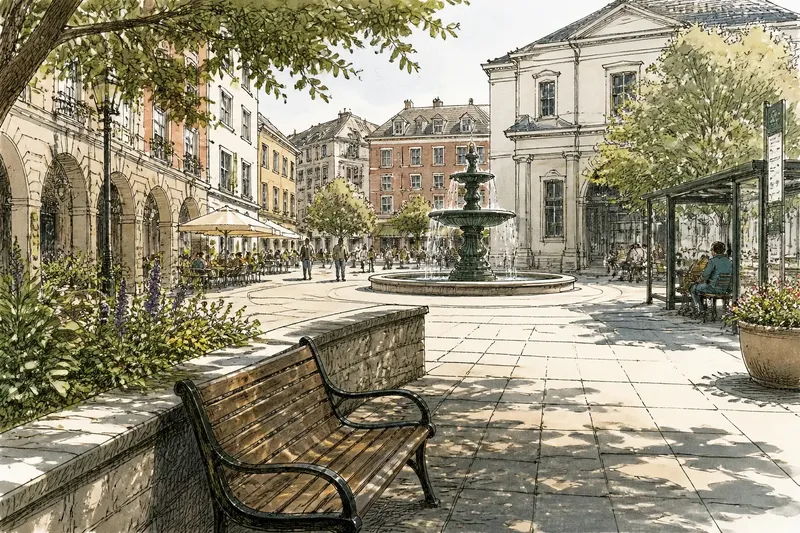
You cross a town square on the way to the library, then notice a low wall catching the afternoon sun and a bench angled towards the fountain. The square has become more than a route. Shared spaces often make this shift possible through ordinary design choices: where people can sit, how paths meet, and whether a passer-by can stop without feeling in the way.
To understand why an open civic space invites a pause, look at it in the order you encounter it. Start at the edge, follow the routes through it, notice where people naturally settle, and consider what the layout communicates about being there. This approach is useful whether you are choosing a place to meet someone or simply trying to understand the character of a local square.
What does a square invite you to do first?
Arriving at a civic space, notice the first choices it offers. Can you enter from several streets, or does one formal gateway make the approach feel directed? Is there a clear view across the space, or do trees and buildings reveal it gradually? These cues affect whether a visitor feels able to wander, needs to keep moving, or might stop to take in the surroundings.
Squares have served many purposes, including trade, public announcements, celebration and informal meeting. A market square may still show signs of its trading role in its broad, unobstructed centre, even when stalls are absent. The open area can also become a venue for performances or a place where neighbours cross paths. The uses need not be scheduled for the space to have social meaning.
Read the setting without assuming a single intended audience. A wide entrance may feel easy to approach, while steps or a raised platform might make the centre more prominent but harder to reach for some visitors. Public-space design can express welcome and still leave practical barriers. Noticing both helps you describe the place as it is, rather than relying on the idea that “public” automatically means equally comfortable for everyone.
How do the edges make lingering possible?
Next, look around the perimeter. The edge is often where a square shifts from open route to place for staying. A bench beside a planting bed, a low wall near a café, or a sheltered arcade can give someone a reason to pause without occupying the main thoroughfare. These are different from the central space, which may be designed to remain clear for circulation or events.
Notice the kind of seating, too. A bench facing another bench can support conversation; one facing a view suits quiet watching. A ledge can offer an informal perch but may not work for everyone. Shade, shelter, lighting and nearby activity also shape how inviting a spot feels at different times. These features communicate possibilities, not instructions: a seat does not demand conversation, and an open plaza does not require participation.
Consider where people can pause without blocking a doorway, crossing route or access point. A useful everyday analogy is a kitchen counter: it can be a place to gather, but only if it does not obstruct the path between the sink and the door. In a square, the edges can serve as the counter, leaving a clear middle for people who are passing through.
What can paths and sightlines tell you?
Follow the routes that connect entrances, nearby streets and useful destinations. A direct, unobstructed path usually signals that passing through is expected. A curved path or a route that skirts a planted area may encourage a slower walk, while paving patterns can distinguish a main crossing from places to sit. Look for the difference between a route that is merely visible and one that is comfortable to use.
Sightlines matter as well. From a seat, can you see an entrance or a familiar landmark? Is there enough open view to understand where the path leads? Clear visibility can help a newcomer orient themselves and choose a place to wait. At the same time, trees, kiosks and public art can make a large open space feel less exposed by breaking it into smaller areas. The design balances orientation with shelter.
Observe how the paths work for people moving at different speeds or using different forms of mobility. A shortcut across a lawn may look convenient but may not be a usable route for someone with a pram, wheelchair or mobility aid. A smooth paved connection and a ramp can make the main space easier to reach. For decisions about accessibility, safety or local requirements, consult the relevant council guidance or a qualified professional.
How can you read a space without mistaking design for a rule?
As you move through, separate what the layout suggests from what it permits. A central fountain may draw people together but also leave little room to sit nearby. A row of café tables may make an edge sociable while signalling that some seating is for customers. Signs, barriers and local customs may clarify how an area is used, but a grand façade alone does not tell you whether lingering is welcome.
Imagine you are meeting a neighbour in a square with a broad paved centre, a bus stop at one edge and a sheltered bench by a library wall. You arrive early, check that the bench is not reserved or obstructing the entrance, then wait there while keeping the path clear. Your neighbour can spot you from the bus stop, and you can talk without standing in the middle of the flow. That small choice makes use of the layout while leaving room for others.
If you are choosing a meeting point, favour a recognisable feature that is easy to reach, then agree on a nearby alternative in case the area is busy or closed. A fountain, noticeboard or distinctive tree can serve as a landmark, but avoid making a person wait in a narrow passage or at a doorway. The aim is not to claim a corner of the square; it is to meet in a way that fits its shared use.
What should you notice when visiting a shared space?
Where can I wait without interrupting people?
Look for a seat or open edge beside, rather than inside, the main walking line. Keep entrances, ramps and crossings unobstructed so others can use them comfortably.
How can I tell whether a space is meant for gathering?
Several entrances, places to sit and visible landmarks can make meeting easier, while a large clear centre may serve events or through-routes. Check signs and the activity already taking place before treating any area as available for a group.
What makes an open square feel less exposed?
Trees, arcades, planting and buildings around the perimeter can give a visitor a sense of shelter without closing off the space. A seat with a view of a path or entrance can also help someone feel oriented.
How do I choose a meeting point in a busy square?
Choose a fixed, recognisable feature away from the busiest crossing, and make sure it is reachable from the approach your companion will use. Agree on a nearby second location in case the first one is occupied.
What changes when people use a square repeatedly?
Repeated visits can add customs that are not written into the paving. Someone may sit on the same bench to read, a group may use the edge of a plaza to catch up after work, or neighbours may recognise one another by the routes they take. These habits can make a place feel familiar, but they remain part of a shared setting rather than ownership of it.
When you visit, notice the ordinary signs of use: a clear path kept open, a bench shared between strangers, or a pause near a public noticeboard. You need not join a group or create an occasion to belong in a civic space. A simple, considerate pause can be enough: choose a suitable edge, leave room for movement, and let the square remain available to the next person. That is how a market square can continue to work as a meeting place, even on a day without a market.