The Tradition Trap: When a Custom Leaves No Room for Change
A living custom can change without losing its meaning. Learn how to tell which parts to keep, adapt or retire so more people can take part.
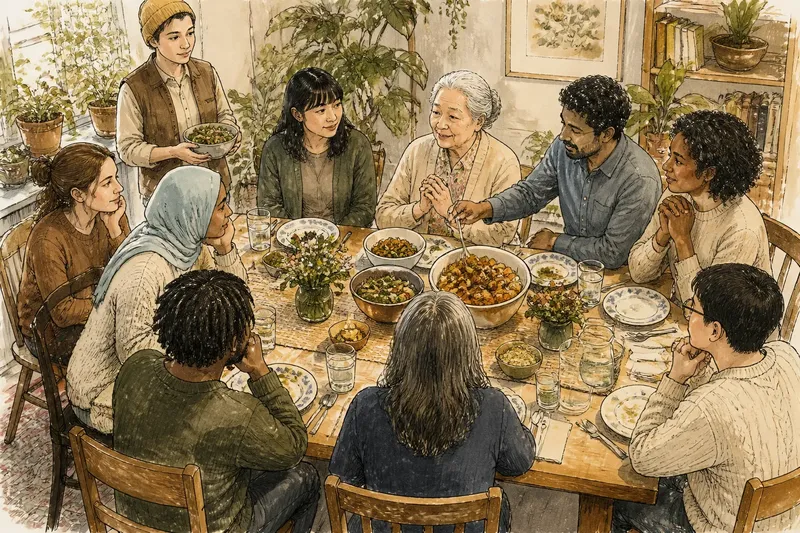
At a shared supper, one person reaches for the serving spoon while another waits for the oldest guest to begin. The pause is familiar, but a new neighbour looks unsure. A custom can make a gathering feel connected; it can also leave someone wondering whether they are allowed to join. The question is not simply whether to keep the tradition. It is what the custom is for, and whether its familiar form still serves that purpose.
The tradition trap is the assumption that adaptation makes a custom less real. In practice, customs often remain meaningful because people keep interpreting them together. A fixed script tells everyone exactly what to do; a living custom preserves a shared intention while leaving room for circumstances, abilities and new participants. Sorting out which kind you have calls for more than a vote between “keep” and “change”.
What is the custom meant to carry?
Begin by naming what the custom does for the people who take part. It might mark a transition, honour someone’s contribution, make space for quiet, or help a group feel that a gathering belongs to everyone rather than only its organiser. These purposes are not interchangeable, so it helps to be specific.
Ask participants what they value about the practice, not only which parts they recognise. Someone may care about sharing a meal, while another values the moment when people take turns speaking. The first may be preserved without a formal speech; the second might need a different format if a group grows or includes people who communicate in other ways.
Separate the purpose from its familiar props and timing. A particular dish, phrase, order of events or room arrangement may be important, but familiarity alone does not tell you whether it is essential. A teapot can be a useful analogy: people may treasure the habit of passing it around, even if the original pot is replaced.
Does the form still fit the people taking part?
Look at who can participate comfortably, who has to watch from the edge and who is expected to carry the work. A custom may appear welcoming to established members while asking newcomers to know an unwritten rule. Another may assume everyone can stand, speak publicly, eat the same food or stay until the end.
Consider access, effort and choice together. A ritual that requires one person to prepare special materials may become a burden if that person is always the same volunteer. A fixed speaking order may help people who appreciate predictability, but feel exposing to those who prefer to listen. Neither observation automatically settles the question; it identifies what the group needs to discuss.
Say a neighbourhood group always opens its monthly meal with a round in which each person shares a personal update. A new member finds speaking in a large circle uncomfortable, and the organiser notices that the opening takes more energy than some people can spare after work. The group could keep the intention of acknowledging one another while offering a choice to speak, pass, or write a note for the shared table. The observable result to look for is whether people can take part without being pressed into the same kind of contribution.
Which situation calls for keeping, adapting or retiring it?
Use the situation, rather than nostalgia or novelty, to guide the decision. A custom need not be defended merely because it is old, and it need not be discarded merely because its original form no longer suits the group.
- Keep it as it is when participants recognise its purpose, can join without undue strain, and the practice still gives the gathering a shared point of reference. Tell newcomers what is happening rather than expecting them to infer the rules.
- Adapt its form when the purpose remains valued but the current arrangement excludes people, creates avoidable work or no longer fits the group. Change the part causing difficulty, while making clear what meaning the group hopes to carry forward.
- Offer more than one way to join when people value the custom but have different preferences or capacities. Speaking, listening, contributing beforehand or taking a quiet role may all serve a shared intention, provided no option is treated as the only proper one.
- Retire it when the group cannot name a present purpose, the practice repeatedly causes harm or resentment, or its responsibilities fall unfairly on someone who does not freely choose them. Recognise what it once meant, then make room for a different way of gathering.
- Pause before deciding when participants disagree about what the custom means or who has authority to change it. Give people time to explain their connection to it, especially those whose experience has been overlooked, before choosing a direction.
These options are not a ranking from most respectful to least. Keeping a custom can be a thoughtful choice; retiring one can be thoughtful too. The question is whether the decision reflects the group’s actual relationships and responsibilities, rather than preserving the appearance of agreement.
Who should have a say in changing it?
Invite the people affected by the custom, not only the people who introduced it or usually lead it. Long-standing members may hold memories that newcomers do not yet share, while newcomers can notice assumptions that have become invisible to regular participants. Each perspective adds context; neither should be used to silence the other.
Make the decision process legible. Explain what is being considered, why the question has arisen, and how people can contribute without having to speak in a crowded meeting. A private conversation, a written note or a small discussion may suit some participants better than a public debate. If one person has been carrying the work, ask what they are willing to continue before promising that a tradition will remain unchanged.
Where a custom is closely connected to a family, faith, cultural community or another group’s specific practice, avoid assuming that outsiders can redefine it on that group’s behalf. Ask the people with a meaningful relationship to it what adaptation would mean, and respect their answer. Shared participation does not make every tradition open for anyone to redesign.
How can you tell whether a changed custom still feels shared?
A revised custom does not need to produce instant consensus. Notice whether participants understand its purpose, whether people can decline a particular role without embarrassment, and whether the work is shared fairly. Also listen for what happens after the gathering: do people describe the practice as something they shaped together, or as a new rule imposed on them?
Give the change a clear point of review rather than treating it as permanent from the outset. The group can agree to try a different form and return to the question after participants have had a chance to experience it. That is not a trial with a pass-or-fail score; it is a way to make adjustment ordinary rather than alarming.
In that conversation, distinguish discomfort with unfamiliarity from evidence that the change is not working. A new version may feel awkward before it becomes familiar, but repeated pressure, uneven labour or exclusion are reasons to reconsider it. Ask what people observed and what they would keep, change or stop, without requiring anyone to defend a personal boundary.
What questions help settle a custom that feels contested?
What should stay the same if the format changes?
Name the purpose participants want to preserve, such as recognition, remembrance or shared responsibility. That gives the group a clearer guide than trying to protect every detail of the old arrangement.
Can someone opt out without being treated as disloyal?
If declining brings teasing, pressure or suspicion, the choice is not fully voluntary. Make room for a quieter role or a respectful pass, and see whether the custom can still express its purpose.
Who is doing the work that keeps it going?
List the preparation, reminders and follow-up that the custom requires, then ask whether those tasks are shared willingly. If they depend on one person’s unpaid effort, adjust the arrangement or release that person from the expectation.
What would tell us it is time to revisit the decision?
Choose observable signs in advance, such as participants repeatedly being left out or the same person feeling obliged to lead. A clear reason to reopen the discussion helps a group adapt without turning every change into a dispute about whether the custom still counts.
How do you make change part of the custom?
Let the group’s explanation of the practice include its permission to adapt. A short spoken note, a message for new participants or a line in a shared gathering guide can say what the custom is meant to do, what people may choose, and who to ask about it. This makes the boundary clearer without turning a flexible practice into another rigid script.
Keep the language plain. “We pause to recognise the people who helped make this meal possible; you can name someone, pass, or add a note to the board” describes a purpose and several ways to join. It does not require every participant to show belonging in the same manner.
For a group deciding whether to keep a custom, the most useful question is not whether the form has stayed untouched. Ask whether its meaning remains recognisable, whether people can participate with dignity, and whether the effort is fairly carried. When those answers point in different directions, the custom may need another conversation, not a verdict about its authenticity.
A tradition can hold continuity and change at once. Treating it as a shared practice rather than a fixed script gives people a way to honour what came before while making space for those who are here now. The next useful act may be modest: explain the custom, invite a choice, or ask the person doing the work what should change.